Postcards from Vietnam
Last week of August, I was fortunate to have travelled to Vietnam. I say fortunate because I loved every bit of it, and hope to be able to travel there again.
We visited Ho Chi Minh City (also called Saigon or HCMC), Da Nang, and Hanoi — the three major cities across South, Central, and North Vietnam respectively. Each of those had a different flavour across the many dimensions — food, culture, traffic, road infrastructure, markets, coffee, among other things. Our trip was for about 8 days, and we definitely felt that was too short to fully soak in the things the country had on offer.
But, it’s better to leave with an incomplete appetite and a desire to return, than otherwise.
It was an excellent trip in absolute sense and in terms of value for money.
History
While Vietnam has had a continuous history of about 3000 years, in the modern era, it’s been a theatre of the different world powers.
Under French colonial rule until World War II, control shifted to Japan after France fell to Nazi Germany in 1940. Following Japan’s surrender, Ho Chi Minh declared independence on 2 September 1945 — a move unrecognised by France or most of the world.
France initiated what became the 1st Indochina war from 1945 to 1954 against Vietnam (and Cambodia and Laos). Mao’s communist China supported Ho Chi Minh with arms and strategy, helping him defeat the French by 1954.
It was the early stages of the Cold War in the 1950s. With only slight exaggeration, there was greater fear around the spread of communism then, than the fear of spread of COVID-19 was in 2020. Ho Chi Minh was a communist leader, and drew support from both USSR and China, at the time.
At the Geneva Conference in 1954, Vietnam was temporarily divided: the communist North (Ho Chi Minh, backed by China and the USSR) and the anti-communist South (US-supported). National elections scheduled for 1956 never happened, as the US moved to block reunification to contain communism — setting the stage for the Vietnam War.
The Vietnam War (1955-1975) and The War Remnants’ Museum
Our trip started from Ho Chi Minh City’s ‘The War Remnants’ Museum’, situated somewhere in the city centre.
There are depictions of various torture techniques used against the guerrillas, North Vietnamese, suspected spies, or even civilians. They are gruesome (drilled teeth, keeping stripped in small barbed wire cages, burning genitals). There’s sections to the international coverage and support received by Vietnam, as well as of the various ammunition, tanks, and aircraft used by US military during the war.
The most significant was the dedicated room to the usage of ‘Agent Orange’ in Vietnam.
Chemical Weapons are classified under ‘weapons of mass destruction’. Same as nuclear weapons (if a notch below). The ones used in Vietnam were herbicides laced with dioxins — extremely dangerous to humans and ecology. They were sprayed in large quantities (~70-90 million litres of it between 1962 to 1971) across vast areas and by their nature, they accumulated in the soil and environment causing exposure for decades after.
The photographs were horrific — generations of Vietnamese disfigured or disabled by chemicals that stayed on in their soil. Images of people born with various birth-defects, adults getting deformed through the chemicals, and many 100,000s dying on exposure.
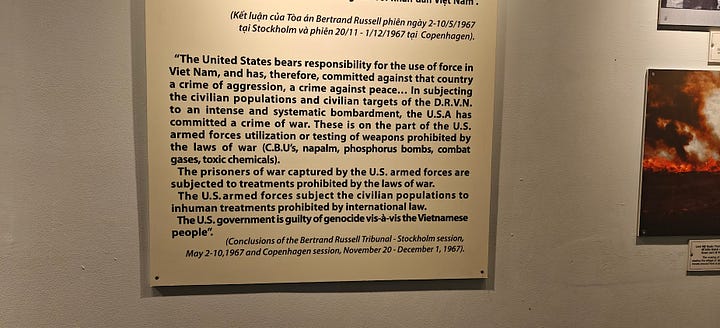

The brave resistance put up by the Vietnamese in recent times has also, probably, ingrained a certain sense of nationalistic pride among the common people.
Not the most upbeat way to start a vacation but the War Museum in Ho Chi Minh City is a strong recommendation to give a sense of this recent history and struggles.
Economy and Culture
After US’ eventual withdrawal (1975) and unification of North and South Vietnam (1976), it continued to struggle with high levels of inflation and poverty a decade into the centralised socialist policies of the newly formed single-party government. On the brink of economic collapse in 1986, it started an era of economic reforms, including ending of centralised planning, legalising private enterprise, creating stock markets, and making efforts towards attracting foreign investments.
In broad strokes, Vietnam’s economic trajectory through the ‘90s was similar to that of India’s. From mid-00s, Vietnam increased its global integration on the back of a manufacturing boom and making use of its labour advantage, tapping the global markets via exports.
In contrast, India’s growth in the ‘00s was service-led with an English-speaking labour edge.
Vietnam: Now — Food, Traffic, Infrastructure, Capitalism, Courtesy, Coffee.
Food


.jpg)


And, with those detours and that context, here we are. To our trip and the Vietnam of today.
I am from Delhi. And have some arrogance about Delhi’s street food being great. This year, I was humbled twice. The first time, when I visited Varanasi (/Benaras) earlier this year, and the second time with HCMC.
It’s not for nothing that HCMC is recognised as a street food capital of the world, and Vietnam was among the favourite destinations of the late great food traveller Anthony Bourdain.
Outside of India, vegetarian food (at least in my wife & my limited experience) can be over-dependent on breads, or be very bland (sometimes both!). Not so in HCMC or Vietnam. There’s a very different taste palate of Vietnamese food, and it’s very flavour-filled without relying on excessive masalas.
One example was the Banh Mi (somewhat like a Subway Sandwich — crisp bread with fillings on the inside) that we had in HCMC from a street vendor (pictured above; last image). Such fresh ingredients, surprisingly crispy tofu, and each bite had a different, yet complementary, flavour!
And, the street food vendors’ dedication was visible on how they took care of serving hygienic, tasty, fresh food, with carefully selected ingredients. It was also visible in how they ensured cleanliness in and around their stalls, even at the end of their day!
While I loved the street food at HCMC best, it was uniformly good at Da Nang and Hanoi too. The same dish — Pho, Banh Mi, Bun Bo e.g. — varies from district to district. We missed going to Hue and that district has its own distinct style of cuisine.
One last aspect on the food — the fruits. It’d be a travesty to not cover about the quality and variety of fruits in Vietnam. Probably with the exception of mango, every other fruit that we tried (dragon fruit, pineapple, rambutan, coconut, grapes, starfruit, jackfruit, orange/mandarin, and a few others that we didn’t recognise) was so juicy, fresh, and somewhat different than in India (often in a good way; a few times in a neutral way).
Traffic and Infrastructure
A particularly amusing sight for me was at the traffic lights. A wave of scooters, as the first responders to the traffic light turning green, suddenly start moving in sync. Both HCMC and Hanoi had very high levels of fast-moving traffic and a high percentage of it as two-wheelers. While there are wide well-built pothole-free arterial roads in both cities, the old parts of the city have narrower single-lane roads. The traffic across both kind of roads is pretty fast-moving, and one instinctively feels cautious crossing the roads (not that they shouldn’t be elsewhere!).
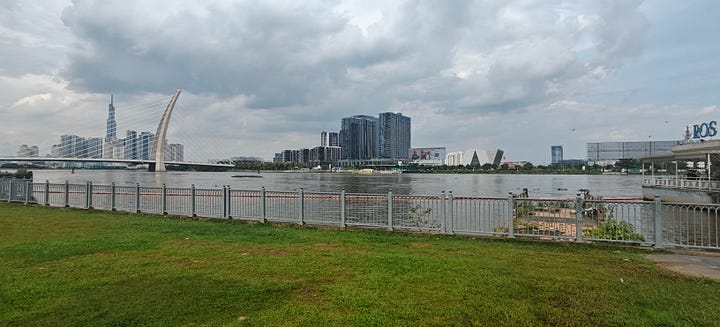


Da Nang, on the other hand, has very wide roads that are far freer for traffic.
Both HCMC and Hanoi, especially HCMC, boast quite a few skyscrapers, bridges, flyovers. Da Nang, less so, but it probably doesn’t require them either. Instead, it boasts of quite a few high-end hotels.
We were also very impressed by the drainage system in Vietnam. On one of the days, we travelled about 40 kms from Hoi An (an ancient town and a UNESCO world heritage site; worth a visit; even worth a stay for a night or few!) to Da Nang. It had already been raining for an hour+ before, and continued raining for two hours+ after we reached Da Nang. And this was heavy rainfall. Pouring. And despite the ~4 hours of heavy rains, there was little to no problem of drainage or waterlogging.
A tropical coastal country that regularly faces high levels of rains and at times hurricanes, has a good urban infrastructure to cope with the rains. Surprisingly surprising!
Capitalism & Courtesy
We were warned by a few people to beware of scamsters, especially in HCMC. “Keep your Delhiite lenses on,” a friend joked.
We bought a few things from there, bargained a fair bit at some of the shops where it was kosher. And I didn’t feel scammed. I might have been. But, given that I don’t know if I’ve been scammed, one can be safe in inferring I wasn’t. The difference between a scam and a mutually beneficial economic transaction really boils down to how you feel after it.
At the shopping complexes, I noticed the store owners at HCMC be far more open to bargain and intent on striking a deal with a customer, than Hanoi. Hanoi would let a customer walk away if going below a certain expected price. Not so at HCMC. They’ll, more often than not, call you back, coax you up, and strike a deal (especially if you were interested and not just whiling away time!).
I also use this as a small metric and identify the capitalism/market-making to be stronger among the people in HCMC compared with that in Hanoi. We didn’t really buy anything (apart from food and fridge magnets) at Da Nang to make any observation of note there.
I mentioned earlier that Vietnam grew on the back of a manufacturing boom. It’s now a hub for manufacturing of electronics, food processing (coffee!), shoes, high quality clothes; another friend recommended getting a suit tailored at any of the cities (in 24 hours!).
But we were also the happy recipients of their service hospitality. I’ve mentioned about the very positive experience with the food and at the street stall vendors. We also had excellent body massages at each of the cities, and had warm hospitable hosts at the various airbnbs.
Grab was our go-to app (for cab or food delivery), and again a very high quality of service professionals all around. They’d be on time even during rain, or apologise promptly (even when not expected!) for any kind of delay.
A very high quality of work ethic overall!
Coffee
Milk/Black Coffee. Salt Coffee. Caramel Coffee. Egg Coffee. Coconut Coffee. Yogurt Coffee. Salted Caramel Coffee. Peanut Butter Coffee.
A few of the coffee options available! And, almost each of these can be served hot or iced. With or without condensed milk.


There’s a genuine confusion whether one should focus on continuing more of what one liked (Salt Coffee, Egg Coffee, Caramel Coffee in that order for me) and try observe differences in the preparation style and taste in the various cities, or make it a point to just have a new one whenever one spots.
You can’t go wrong with either.
Itinerary and Recommendations
We started at South Vietnam and moved to Central followed by North, before returning to Delhi. We spent 2 days at HCMC (should’ve spent more), 2.5 days at Da Nang (including half a day at Hoi An), 2 days at Hanoi, and 1 day (via Hanoi) at a Cruise that we boarded from Ha Long Bay. We heard that we should’ve gone to Hue as well. We could’ve also spent more time at Hoi An at the cost of some time at Da Nang. But, it would’ve made it all a lot more hectic or been a longer trip.
Some people split it into two trips — south and central separately and central and north separately. Or, South (HCMC) and North, skipping the central. Some others add a rural side of Vietnam to the trip too.
We used flights to travel between the major cities — it was cheaper and saving us on the time. Some others choose trains but they’re not a short journey of a couple of hours, between these cities.
For food — we carried a few ready-to-eat packs but didn’t have to use any. There were plenty of excellent vegetarian and vegan options. There were also a few Indian restaurants available, if one were to prefer that.
Credit Cards are accepted in most places and services like Grab have online payment options for cabs and food delivery. I’d still recommend carrying some amount of cash, especially for smaller places or smaller amounts. If you’re travelling from India, I’d suggest converting a very basic amount to VND (Vietnamese Dong) and rest to USD. If one needs more local currency, one can convert the USD to VND there, at far favourable conversion rates, and return with leftover USD to convert back in India.
We were warned about the rain; in fact before landing at Da Nang, we also came to know of a hurricane headed towards it. Fortunately, the hurricane changed course. Due to the initial rain warning, we kept the HCMC leg to the minimum. In retrospect, it didn’t rain at all at HCMC. Also, we carried rain coats (preferred over umbrellas for ease of packing and movement) and that came pretty handy, especially at Da Nang and Hanoi. A few treks, especially in Da Nang, and the cruise at Ha Long Bay (via Hanoi) could be adversely impacted by rain but one can continue with most other activities as normal, otherwise.
Shopping — would suggest buying clothes or shoes at HCMC, if you’re visiting there. We didn’t purchase but were told for shoes there were both “Made in Vietnam” and “Made in Indonesia” ones available. We were recommended for the first (didn’t try first-hand). Also, for the clothes — depending on where you’re buying from, it may be a ‘first copy’. So be warned and go in with right expectations. I imagine purchasing electronics would be the same throughout Vietnam (assumption).
Conclusion
2025 was a special year for Vietnam. 30th April was the 50th anniversary of US’ evacuation and 2nd September 2025 marked the 80th anniversary of Vietnam’s National Day (independence from France in 1945). I didn’t know of either but saw them practising late at night, near the main stage in Hanoi (old quarters, near the lake) for the National Day.


I definitely hope to return to Vietnam and would wish it well. For the spirit and hardworking nature of its people, for their courteousness, and simplicity.
To end, here’s a particularly catchy Vietnamese song that was being played during our return flight to Delhi and became quite a bit of an earworm.
Comments
Post a Comment