Replug: On Majoriticism, Reviews, Peepli Live, Normal Curve and More
I committed myself to putting one post a month. That did not work out so well. So, I am putting an earlier article that was published at my b-school's blog here
On a recent trip to Delhi, I stumbled on a car with a slogan saying: ‘Singh is better than king,’ and as it would happen, a friend wrote an article on a related topic here (NOT a shameless plug for the said friend). It got me thinking on certain things. A movie like Singh is King or even 3 Idiots (yes! The one hailed as the next best thing since Rang De Basanti – another falling into this category that I am talking of) has a certain kind of an impact on the audience.

Now, because we are so jobless – me in writing this article and you in reading it – you might just as well do well to imagine a normal curve. Now imagine one (and only one specific) quality of a film or a film maker which defines the quality of the movie made and assume this quality to be distributed along the normal curve. Now, this quality in itself would be a function of a multitude of things including, intelligence, clarity of vision, control over technique, actual knowledge of technique/craft etc. Also, assume that ‘intelligence’ is good enough a term to supersede all of these individual terms and qualities. This basically means that each filmmaker makes a movie that falls somewhere along the normal curve with the position on the curve being a function of the intelligence of the movie-maker.
Now, imagine another normal curve. This time, take the function of that normal curve to be the ability to get (and like) a movie. Even this curve, given a million assumptions and one, can be thought to be a function of intelligence – of the moviegoer this time.
Superimpose the two curves in such a way that the averages of the two curves aren’t the same, but merely parallel and separated by a certain horizontal distance signifying the higher average intelligence of the movie-maker than the movie-goer (fine! I think the average movie-maker is smarter than the average movie-goer. No scientific/logical reason to believe so. Go sue me! :P).
Now, imagine another normal curve. This time, take the function of that normal curve to be the ability to get (and like) a movie. Even this curve, given a million assumptions and one, can be thought to be a function of intelligence – of the moviegoer this time.
Superimpose the two curves in such a way that the averages of the two curves aren’t the same, but merely parallel and separated by a certain horizontal distance signifying the higher average intelligence of the movie-maker than the movie-goer (fine! I think the average movie-maker is smarter than the average movie-goer. No scientific/logical reason to believe so. Go sue me! :P).
Now, most movie-makers tend to make a movie appealing to the mean of the audience-normal-curve and there is a reason for that. The movies lying on the far-right of the curve (e.g. say Inception, Peepli Live etc.) invariably divide the audience into two kinds. At the cost of sounding heavily condescending and simplistic (pardon me FSM!) the audience falling to the left of the movie, find it hard to understand (or too realistic, or too arty and so on) and thus ignore it, while those to the right try to prove themselves to be on the right by highlighting the million ignorable mistakes instead of focusing on the superb aspects of it. Some movies from the hindi scene which, I thought, tried to push the boundaries but failed: Hey Ram, Mithya, Love, Sex aur Dhokha – three absolutely ground-breaking movies which deserved better.
The logical extension of this theory of course debunks the entire critics’ society as a bunch of people trying to prove to be more intelligent than the filmmaker. That isn’t the point. I immensely respect some of the critics and I think a minority from the community go beyond their position in the intelligence curve to actually ‘judge’ the position of the movie on the curve fairly well. (Case in point: two of my favourite ‘mainstream’ critics.) The point is about the divided opinion of the ‘classes’ (or the right extreme of the normal curve). The point is in the essential difficulty of saddling the path of appeasing everybody in the ‘classes’. So, we have the Rang De Basantis and the Singh is Kings ‘empowering’ the common viewer into believing whatever they want to, and achieving pop culture acceptance.
The easier path? Screw the classes, go for the mean. Mean is where the moolah is. The people on the left of the curve want to identify with the majority (which is perfectly valid) but sadly, the people on the slight-right don’t want to pursue the further-right! The irritatingly simple-yet-uncounterable argument offered being: “I watch a movie for entertainment and if real life were to really be as entertaining, wouldn’t I rather lead my life than watch a movie about my life?” Irritating is the word.
The desired path? A path that leads to movies giving more on each viewing to the classes while appeasing the ‘entertainment v/s reality’ argument by providing with sufficient entertainment. Case in point: Omkara, Wall-E, The Prestige, The Dark Knight, Eternal Sunshine of the Spotless Mind et. al. To me, Vishal Bhardwaj offers most hope in the hindi cinema scene of walking on the ‘desired path’, with people like Dibakar Banerjee and Anurag Kashyap trying to go more the classy-way. I think, Chris and John Nolan most famously achieve the balance in Hollywood with Charlie Kaufman taking the role of not just pushing the proverbial envelope but in fact, the whole of post box down the audience. Always. (Recommended viewing: Synecdoche, New York.)
The logical extension of this theory of course debunks the entire critics’ society as a bunch of people trying to prove to be more intelligent than the filmmaker. That isn’t the point. I immensely respect some of the critics and I think a minority from the community go beyond their position in the intelligence curve to actually ‘judge’ the position of the movie on the curve fairly well. (Case in point: two of my favourite ‘mainstream’ critics.) The point is about the divided opinion of the ‘classes’ (or the right extreme of the normal curve). The point is in the essential difficulty of saddling the path of appeasing everybody in the ‘classes’. So, we have the Rang De Basantis and the Singh is Kings ‘empowering’ the common viewer into believing whatever they want to, and achieving pop culture acceptance.
The easier path? Screw the classes, go for the mean. Mean is where the moolah is. The people on the left of the curve want to identify with the majority (which is perfectly valid) but sadly, the people on the slight-right don’t want to pursue the further-right! The irritatingly simple-yet-uncounterable argument offered being: “I watch a movie for entertainment and if real life were to really be as entertaining, wouldn’t I rather lead my life than watch a movie about my life?” Irritating is the word.
The desired path? A path that leads to movies giving more on each viewing to the classes while appeasing the ‘entertainment v/s reality’ argument by providing with sufficient entertainment. Case in point: Omkara, Wall-E, The Prestige, The Dark Knight, Eternal Sunshine of the Spotless Mind et. al. To me, Vishal Bhardwaj offers most hope in the hindi cinema scene of walking on the ‘desired path’, with people like Dibakar Banerjee and Anurag Kashyap trying to go more the classy-way. I think, Chris and John Nolan most famously achieve the balance in Hollywood with Charlie Kaufman taking the role of not just pushing the proverbial envelope but in fact, the whole of post box down the audience. Always. (Recommended viewing: Synecdoche, New York.)
Okay. So having reached here, with/without having read the entire article till here, I’ll make the easier assumption of you being somewhat convinced with the above. Except, probably about the objectivity of it all. So, a film-maker has a fixed point on the normal curve and doesn’t make movies of varying quality? A viewer can’t relocate his position on the curve? Err, well, so in my utter joblessness, I make a patently-innovative (my world. my article. I term it innovative. :P) change to the model. Different people shift from movie-to-movie depending on their mood. So, I shift from not-getting-the-greats -  2001: A Space Odyssey, One Flew Over The Cuckoo’s Nest, and Taxidriver (I don’t like them. There, I said it!) to loving-the-recognised-genius of Cidade de Dues and Perfume: The Story of a Murderer (my absolute favourite films!). So only a Ram Gopal Verma shifts from a blood brilliant Satya to a to-be-watched-only-on-being-paid Sarkar and Kamal Haasan shifts from Mahanadhi/Hey Ram to Aalavandhan/Abhay (for all practical purposes both probably directed by him) – and mind you, I think Abhay had a brilliant one-line concept ruined by his indulgence for all the things that caught his attention during the making.
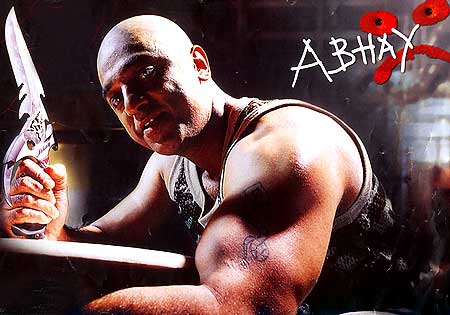 2001: A Space Odyssey, One Flew Over The Cuckoo’s Nest, and Taxidriver (I don’t like them. There, I said it!) to loving-the-recognised-genius of Cidade de Dues and Perfume: The Story of a Murderer (my absolute favourite films!). So only a Ram Gopal Verma shifts from a blood brilliant Satya to a to-be-watched-only-on-being-paid Sarkar and Kamal Haasan shifts from Mahanadhi/Hey Ram to Aalavandhan/Abhay (for all practical purposes both probably directed by him) – and mind you, I think Abhay had a brilliant one-line concept ruined by his indulgence for all the things that caught his attention during the making.
Comments
Post a Comment